

French soda siphons, eau de seltz bottles, are handsome objects: a heavy pressurised glass body, a metal head and lever, and the bottler's name etched around the shoulder. They turn up frequently at every brocante in France. Cobalt blue, chromium green, iron-tinted aqua – the colour was mostly a cheap way of disguising the industrial quality of the glass, and the overwhelming majority of them contain no uranium at all.
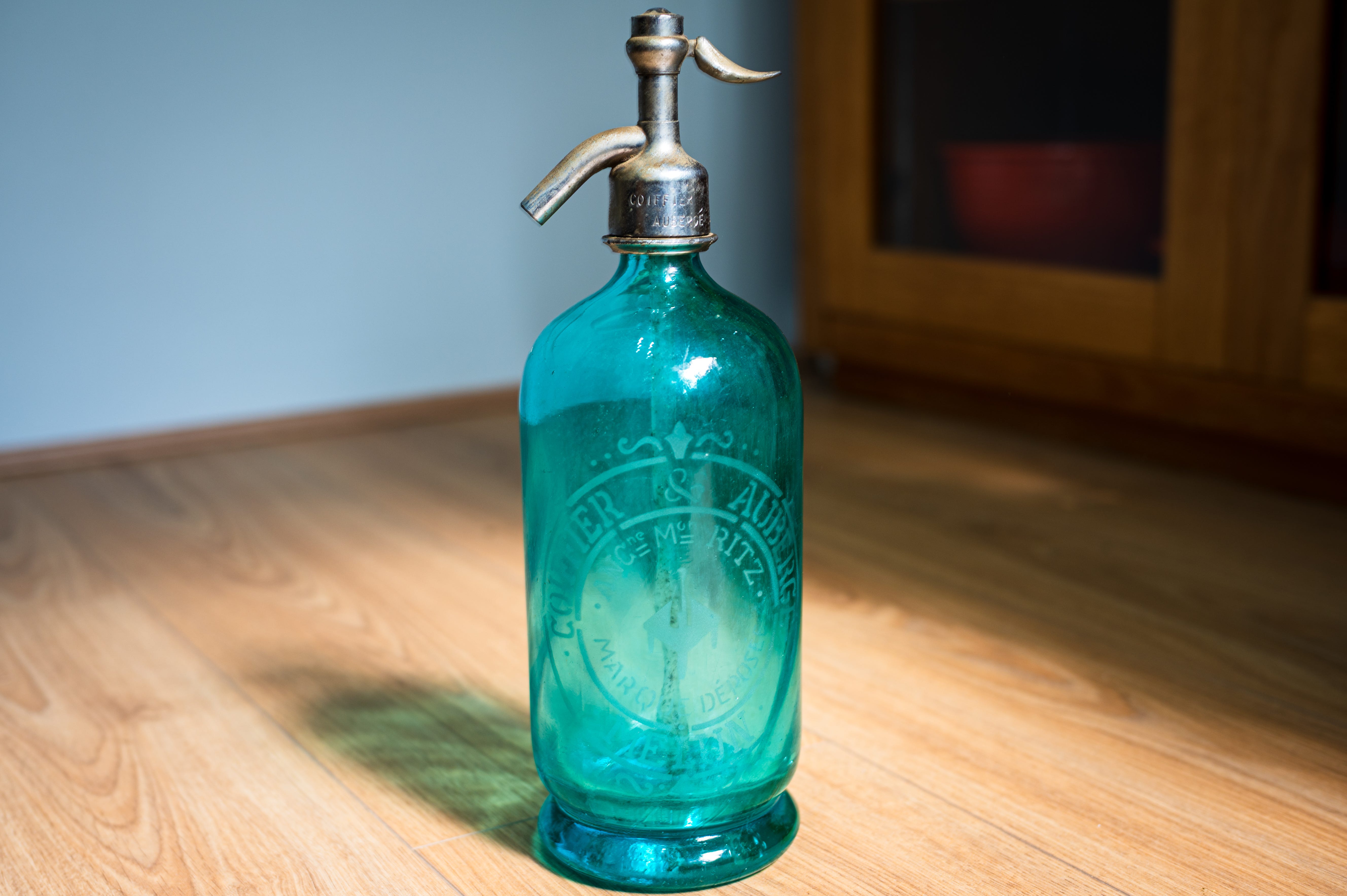
I came across the pictured Siphon last week in France, exploring Brittany with my family for my dad’s 70th. Whilst on my travels - for work or pleasure - I always keep an eye out for cluttered antique shops to explore. Not easy in France, where there seems to be a bias towards arty establishments, with each antiquity carefully selected and placed (and, of course, priced).
There are exceptions to the rule though. This item was found just outside of Saint-Malo by car, in a small antique shop that seemed to sit in the middle of pretty much nothing, surrounded by houses and very little else. No ferry footfall, no English spoken, no pricing aimed at tourists, and the good sort of chaos inside – stock from essentially any decade you care to name, stacked and shelved with no discernible system.
Yes, it’s blue
Or perhaps better described as teal blue, which is precisely why it is interesting. To an untrained eye, it is not uranium glass, and to most trained eyes it isn’t either. Vaseline glass announces itself in daylight with that yellow-green you learn to spot across a room or that darker depression green we’re all familiar with. Teal reads instead as iron in the sand, or cobalt, or copper. Nothing about this bottle in ordinary light says uranium.
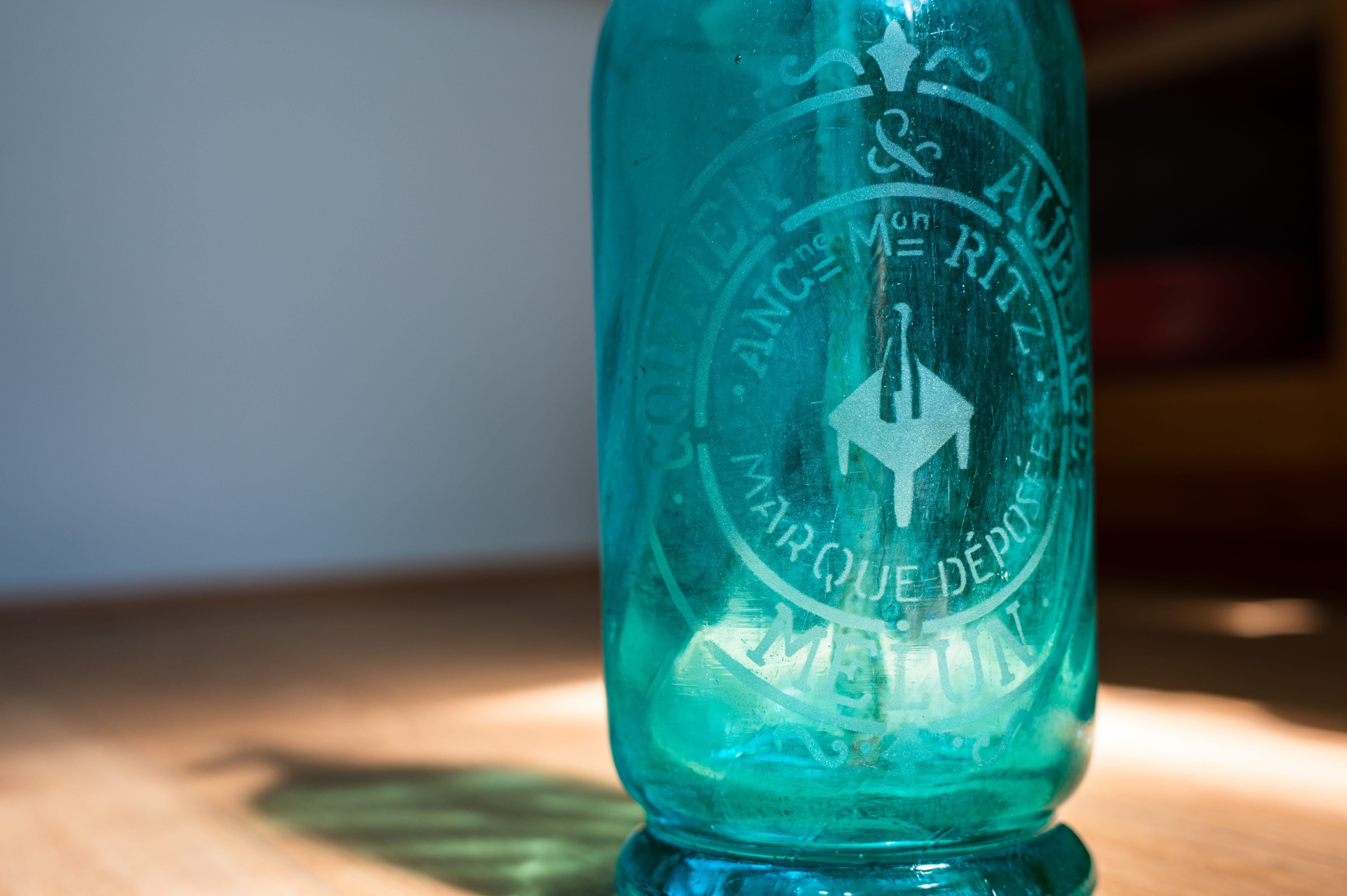
But blue and teal uranium glass is a real category, if a minority one. Uranium oxide added alongside cobalt or copper gives you a base colour nowhere near canary yellow while keeping the full fluorescence and the full activity. I have been at this long enough to have watched pieces exactly like this light up, so out came the torch.
Yes, green. Properly green.
Fact sheet…
Discovered: A small antique shop ten minutes outside Saint-Malo, Brittany, France
Age: Circa 1900s–1930s
Radioactivity: Roughly 11.0 cps sustained, above my home background, levelled at 0.14 uSv/hr
Bottler: Coiffier, of Melun, Seine-et-Marne (about 45km southeast of Paris)
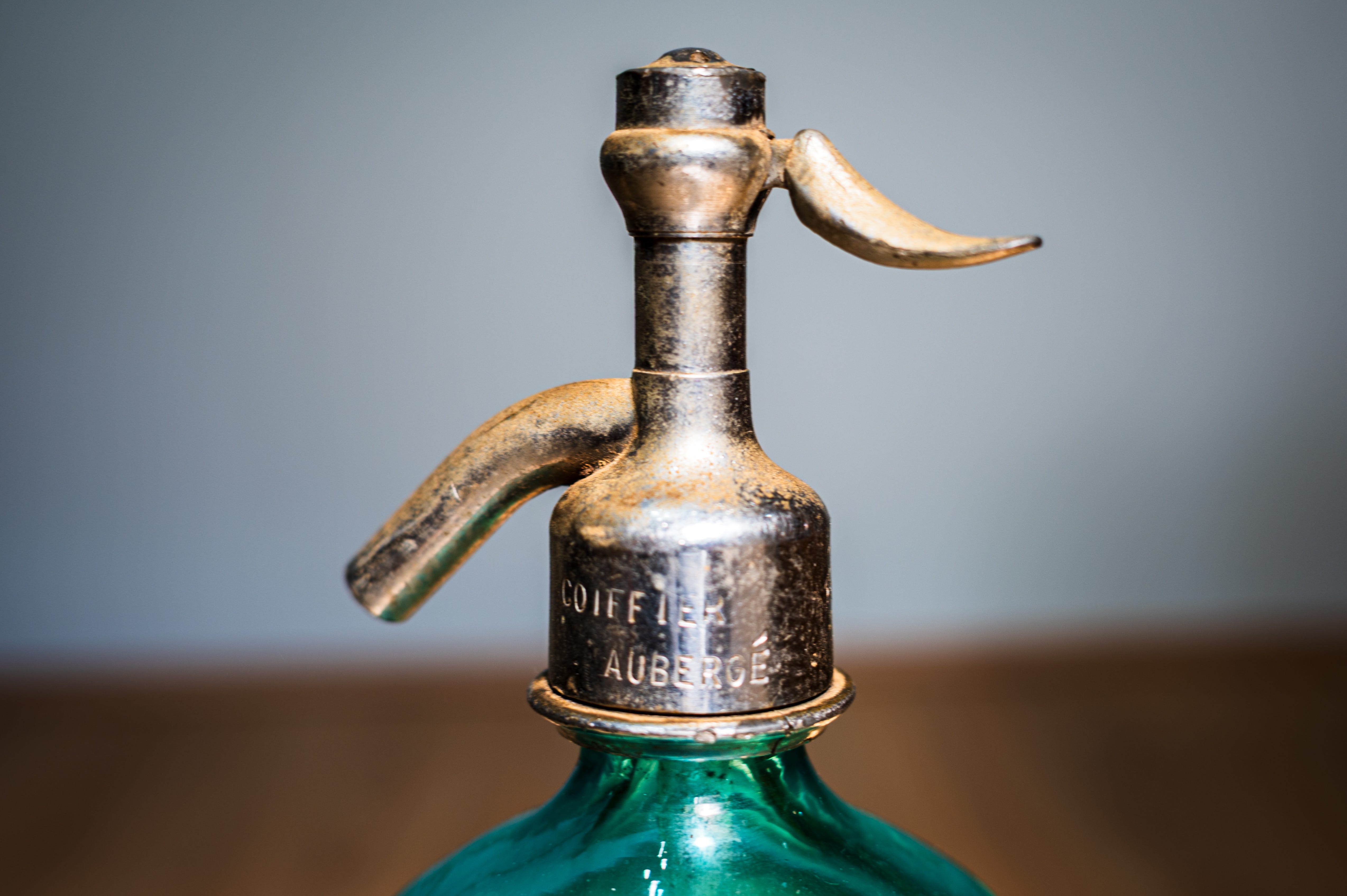
History of the bottler: Coiffier appears in none of the French siphon collector references I can find, which suggests a modest regional operation rather than a named brand. The glass is etched Ancienne Maison, a standard French commercial formula meaning “formerly the firm of”, so Coiffier took over an established bottling business rather than starting one. There is a circular déposée mark, the registered trademark stamp, and on the metal head a different name entirely: L’Auberge.
Why the glow wasn’t enough
Manganese dioxide was the standard decolouriser in commercial glass for decades, added to cancel the green cast that iron impurities give cheap sand. Manganese glass also fluoresces green under UV. It is usually fainter, more muted, and sometimes uneven, pooling at seams and thick sections, but photographs flatten exactly those distinctions. Selenium only displaced manganese from around the First World War onwards, which puts a bottle of this vintage squarely in the manganese window.
And manganese glass is completely inert. It will not move a detector by a single count. So I wasn’t satisfied. I got the Radiacode out.
Background first, taken a few feet away, then the detector placed directly against the glass body rather than the metal head. 11.0 counts per second, sitting well above my home background, and staying there. I ran two accumulations, one out to 4:49 and one out to 8:28, and both settled on the same figure.
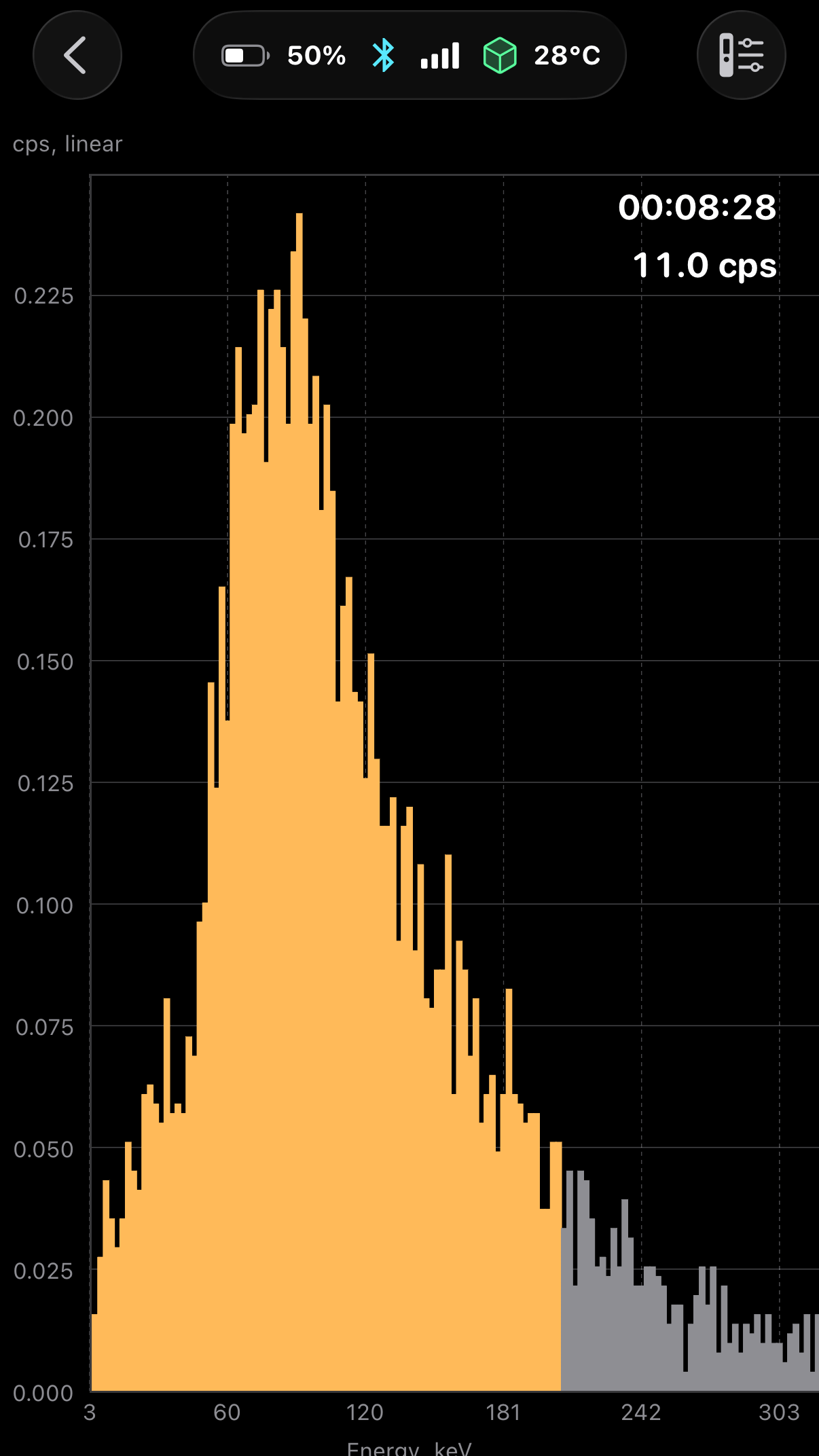
The spectrum closed the case: one sharp peak in the region of 70 to 90 keV, standing dramatically above the background trace at the same energies, and nothing meaningful further along the axis. That is textbook uranium glass. The low-energy peak comes from thorium-234 and protactinium-234m, the immediate daughters of uranium-238. Their half-lives run in hours and days, so they reach equilibrium with the parent almost instantly and throw up that spike. Further out, where bismuth-214 and lead-214 would sit at 352, 609 and 1120 keV, there was nothing at all.
That’s exactly right: those later radium-series daughters take tens of thousands of years to build up from chemically purified uranium oxide, so a century-old piece of uranium glass shows the front of the decay chain and none of the back. A radium dial item, by contrast, lights those higher lines up straight away.
Uranium. Confirmed.
Dating it
Uranium glass production peaked from the 1880s to the early 1940s, then effectively stopped around 1942 when supplies were requisitioned for the war effort. Nothing resumed until roughly 1958, and post-1958 glass used depleted uranium, which doesn’t present the same way on a spectrum.
The French pressurised glass siphon, meanwhile, was made and circulated from around 1900 until 1952, when the design was withdrawn on safety grounds. Pressurised glass in domestic use is an argument that loses eventually!
Overlap those two and the natural-uranium signature on my spectrum rules out anything from the later era. That puts the bottle between 1900 and the early 1940s, most likely the 1920s or 1930s.


The name on the head
Siphons of this era were never sold to the public. They were company property: filled centrally, delivered to cafés, hotels and inns, collected empty, refilled, sent out again. Both the glass body and the metal head were reusable, and both were trackable, which is why they carry two sets of markings – the bottler on the body, the client establishment on the cap.
So L’Auberge on the head is almost certainly the specific inn this bottle was assigned to. What I brought home is a working piece of kit from a small bottling business in Melun, in service at a named inn, most probably in the 1920s or 1930s.
How rare is it?
Honestly, hard to pin down. Uranium glass siphons are a documented thing in the trade, with French examples attributed to bottlers including E. Balzinger and Barre Quessy, and at least one clearly documented blue uranium siphon from an American bottler. What they are not is a standard listed category in the siphon reference works, because almost all siphons are ordinary tinted glass.
Worth saying too that France is not virgin territory for this hobby. The French call uranium glass ouraline, generally place its golden age between 1880 and 1920, and collect it keenly – Portieux, Vallerysthal, Baccarat and Saint-Louis pieces all have an established market. What is thin on the ground is documentation of siphons specifically, and of small provincial bottlers like Coiffier in particular.
So, a teal uranium glass siphon from an undocumented regional bottler. Not unique. Genuinely uncommon. I’ll take it!