

Kingswood Mine sits just west of Buckfastleigh in South Devon, tucked into the lower slopes of Dartmoor. The mine takes its name from the wood it was driven into. To get anywhere near the adit today, you have to carefully push through dense woodland, brambles, and a generous layer of stinging nettles - the kind of UK wood that, given a century to itself, has done a thorough job of swallowing whatever humans left behind.
Despite being widely regarded as the most radioactive mine adit in Devon - and, after South Terras in Cornwall, arguably the second most radioactive in the UK - it is genuinely hard to find. Which feels strange for a site that was briefly reported in The Times, Nature, and the local Devon press.
Fact sheet…
Location: Near Hapstead, just west of Buckfastleigh, South Devon
Worked: Adit driven 1918–1920; earlier copper trials in the 19th century on the same estate
Discovered: Pitchblende lode reported in The Times on 18 January 1919
Primary minerals: Pitchblende (uraninite), with coffinite, nickel, cobalt, bismuth, copper and arsenic minerals
Reported ore grade (1919): Over 26% uranium oxide - about thirteen times richer than the American ore being imported at the time
My reading at the adit entrance: 0.22 µSv/h on the Radiacode (roughly 1.5–2× typical UK natural background)
Published radon level inside the adit: up to 37,000 Bq/m³ (Gillmore et al., 2001) - about 185× the UK domestic action level
A 1919 sensation
Kingswood mine was originally on the owned estate of Friend Sykes, the man who would later become better known as one of the founders of the British organic farming movement and an early Soil Association member. In 1919, however, he was Lord of the Manor of Brooke Mainbow and - according to contemporary press accounts collected by Legendary Dartmoor - a chemical engineer who had previously made his name producing acetone for the war effort, with a sideline in amateur geology.
Apparently, whilst out shooting one day in King’s Wood, Sykes spotted an interesting outcrop, eventually bringing a former miner named Isaac Hendy out of retirement at about 80 years old to act as mine captain, and driving an adit from the valley floor into the hillside. After more than a year of work and a fair amount of local mockery, a charge blew out a piece of quartz with strange black markings. Sykes recognised it as carrying nickel, cobalt and bismuth - the calling-card minerals for pitchblende. A sample was taken to University College London, where a Dr Henry Terry analysed it and confirmed the uranium oxide content of over 26%.
The find was significant enough that Nature ran a short note in 1919 recording it as the first time pitchblende ore had been recorded from Devon, citing The Times of 18 January 1919 as the original source. The Ministry of Munitions’ Mineral Resources Development Department got involved, sending the mineralogist Lieutenant Arthur Russell - later Sir Arthur Russell, 6th Baronet, and arguably the most important British mineral collector of the 20th century - to inspect the workings. Russell’s original report on Kingswood is still held at the National Archives, and he later presented his findings as a paper, “On a discovery of pitchblende at Kingswood mine, Buckfastleigh”, to the Mineralogical Society in February 1922. The opinion of Professor J. Norman Collie of UCL - Sir William Ramsay’s collaborator on the isolation of argon and helium, both of which had involved pitchblende - was also sought, along with that of a director of what was then the UK’s only radium factory.
Why it never paid
For a brief moment, Sykes was sitting on what looked like a fortune. Radium at the time was selling for around £400,000 an ounce, and contemporary press estimates of the value of ore already sitting in the dumps from earlier copper work ran into six figures.
And then… nothing. No large-scale operation ever materialised. The geologist A. K. Hamilton Jenkin, writing in The Mines of Devon and cited by the Open University Geological Society, later described the second lode as containing only a small lens or pocket of pitchblende - enough to excite a chemist with a hand specimen, not enough to justify a working mine. The deposit was simply too small and too localised to be economic. The adit was abandoned and the wood began its slow reclamation.
The 1949 hush-hush survey
The story isn’t quite over, though. In April 1949, with Britain pursuing its own atomic weapons programme, the government quietly returned to King’s Wood. Local press at the time reported workmen digging near Hapstead Farm under “hush hush” instructions, a shaft being investigated, and a tributary of the local stream testing radioactive enough to alarm residents and fishermen. The site was rumoured to be used as a training ground where Commonwealth prospectors could practise hunting uranium with Geiger counters. The National Archives still holds a Ministry of Supply file titled simply “Raw materials: uranium; Kingswood mine, on Dartington Hall estate, Buckfastleigh, Devon” - a thin paper trail for what appears to have been a serious post-war reassessment of Britain’s domestic uranium reserves. It clearly went nowhere. Britain ended up sourcing uranium from elsewhere, and Kingswood was returned to the trees.
What I actually found - and what the meter said
I’d love to say I emerged with a sample of UK pitchblende. I didn’t. In fact, I briefly visited to witness the history of the mine, and then left.
On the way to the mine, my Radiacode was reading more or less normal background. Things started to climb at perhaps 200 metres from the adit - though it’s worth flagging that the dirt tracks running through the wood may themselves be slightly raising readings, quite common given waste materials from mining sites are often used to build paths around them. At the adit entrance itself, the Radiacode settled at around 0.22 µSv/h - somewhere between one-and-a-half and twice the typical UK background of about 0.10–0.13 µSv/h. Not dramatic, but a clear, sustained elevation, and audibly busier on the counts.
That figure tallies neatly with the published Geiger counter readings on Mindat by the surveyor Virginia Maine. Her measurements give a useful map of how the gamma field climbs as you head into the mine:
Local background (about 200 m from the adit): ~12 counts per second
At the adit entrance: ~25 cps — roughly 2× background
First metre inside the adit: ~50 cps
Through the body of the adit: ~50 cps (broadly stable)
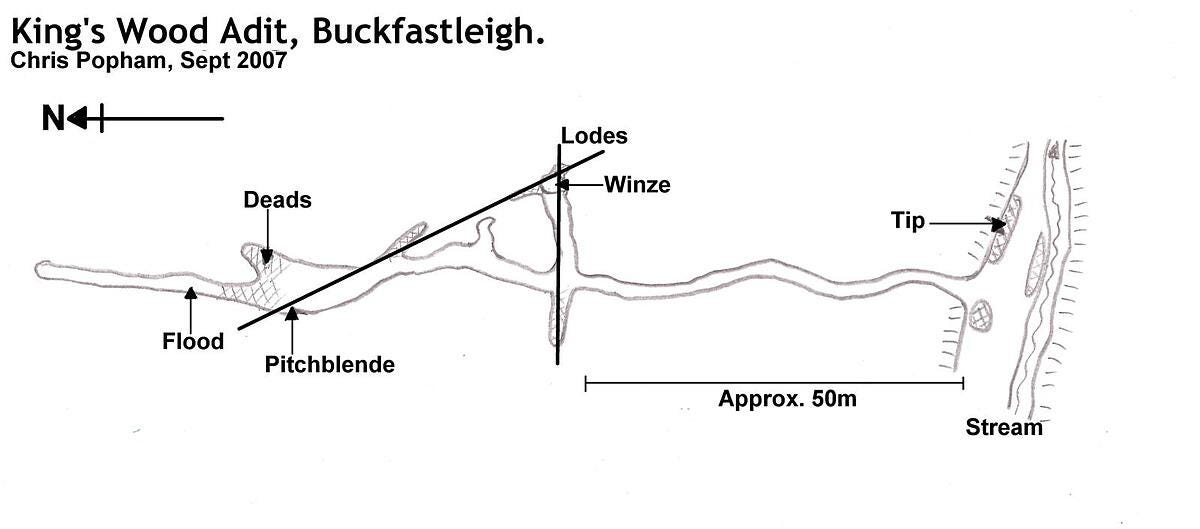
Pitchblende chamber, about 70 m in: over 1,000 cps
At exposed pitchblende in the wall and roof: over 2,000 cps — around 170× local background
My 0.22 µSv/h at the entrance maps neatly onto her 2× factor. Extrapolating that ratio into the pitchblende chamber, a Radiacode at that point would likely be reading somewhere in the region of 10–20 µSv/h of gamma - roughly 100× UK background, and the kind of figure I usually associate with handling a hot WW1 compass at very close range, except that here the source is all around you rather than 20 cm in front of you.
And gamma is only the visible part. The real hazard inside the adit is radon. Radon is a colourless, odourless, denser-than-air radioactive gas that emerges continuously from uranium-bearing rock, and it irradiates your lungs from the inside via its alpha-emitting decay products — exactly the mechanism that produced the lung-cancer epidemic among the Joachimsthal silver miners. The Gillmore et al. (2001) survey, which sampled both South Terras and Kingswood between 1992 and 2000, measured Kingswood at a maximum of around 37,000 Bq/m³. For scale:
Typical UK outdoor air: about 10 Bq/m³
WHO indoor reference level: 100 Bq/m³
UK domestic action level: 200 Bq/m³ — Kingswood is roughly 185× this
UK workplace action level: 400 Bq/m³
Gillmore et al. then go on to do a dose calculation for Kingswood that’s worth quoting in summary: a single two-hour visit at those concentrations gives roughly 0.6 mSv of effective dose - meaning two visits would exceed the UK’s 1 mSv/year statutory limit for members of the public. Compared to South Terras, where the same team recorded one of the highest radon levels in Europe at about 3.93 million Bq/m³, Kingswood is the calmer of the two. That is not a high bar.
Bad air, and a wave of faintness
Something else I noticed near the adit: a slight wave of faintness. I want to be careful about over-attributing it - I’d been climbing through brambles and nettles for some time, I was hot, and I was running on a fair bit of adrenaline. Any of that would account for it. But the other plausible explanation, which I think is worth airing for anyone considering visiting old mines, is bad air.
“Bad air”, or blackdamp in the older miner’s vocabulary, is what you get when oxygen has been displaced or consumed underground - typically by rock and timber oxidation, water-rock chemistry, or the slow accumulation of carbon dioxide and radon. Both CO₂ and radon are denser than air and pool in low ground. Old adits are not sealed systems; they “breathe” in and out with barometric pressure changes, and they can vent oxygen-depleted, CO₂- and radon-rich air to the surface - particularly when, as at Kingswood, the adit was driven from the valley floor and sits at the bottom of a wooded combe with little airflow. Studies of gas emissions from old mines have documented this kind of natural thermal venting reaching surface buildings and surrounding land. The Kingswood adit has been quietly stewing for over a century with 37,000 Bq/m³ of radon inside, and standing at the entrance, breathing whatever the mine wants to push out is not necessarily the same as standing in a normal Devon wood.
I’m not going to claim with certainty that I was breathing bad air. I might just have been short of water and full of antihistamine. But it’s the right working hypothesis for the location, and it gave me one more reason to be conservative about how close I lingered.
Why I didn’t go in
Three reasons:
I was solo. Never a clever way to explore an abandoned mine.
I had no PPE. No respirator, no protective suit, no dosimetry beyond the Radiacode itself - and the Radiacode is a gamma scintillator. It tells me nothing useful about the alpha dose I’d be breathing in from the radon.
The numbers above. Two visits exceed my annual statutory dose limit. One visit, especially without breathing protection, isn’t worth a sample I could photograph from existing Mindat surveys.
I didn’t find pitchblende on the surface either. To be fair, I didn’t spend long looking - and given that mineralogists have been visiting this site on and off for more than a century, it’s reasonable to assume the obvious external hand specimens have long since been collected. Documented surveys on Mindat note that pitchblende-bearing slate slabs have been recovered from the spoil at the adit entrance in the past, with one published reading of greater than 1,000 counts per second at 30 cm. They’re just not lying around in 2026 for the casual visitor.
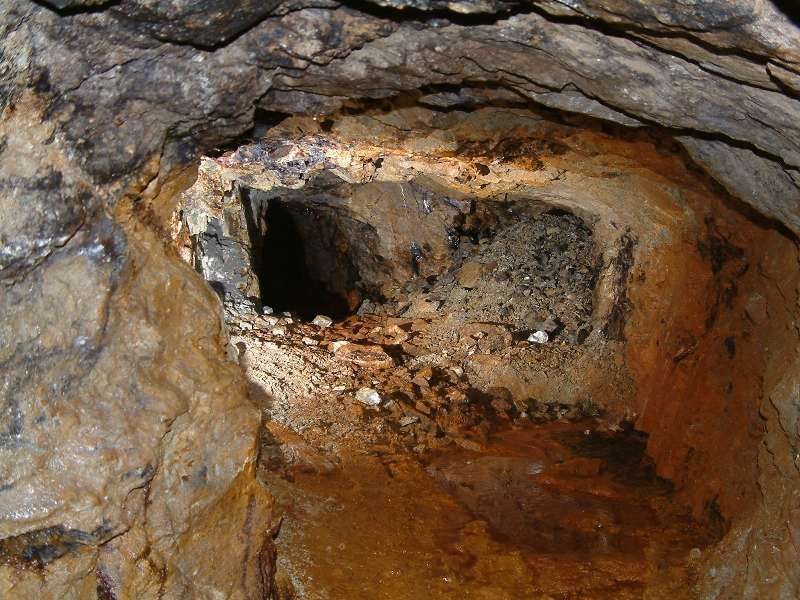
The pitchblende itself is still there, of course - exposed in the lode roughly 70 metres into the adit, where Chris Popham’s early-2000s photographs on Mindat show black patches of it through the rock. Could you collect a museum-grade sample? Almost certainly. Should you? Absolutely not. As one experienced mine explorer is quoted as saying about the site: a single speck of radioactive dust inhaled today can sit in your lung and do its work twenty years from now.
A mine going quietly back to the wood
What struck me most, climbing back out through the nettles, is how completely the landscape has reclaimed this place. There’s no signage. Nothing tells the casual walker that they’re standing near what was once a national news story, a Ministry of Munitions site, and a post-war atomic survey target. In another fifty years, with no surface workings to maintain and no economic reason to revisit it, Kingswood may pass entirely out of living memory - known only to mineralogists, mine historians, and the occasional Radiacode-toting Substacker with a death wish for his shins.
That feels like a loss worth marking. Not because the mine should be reopened - it shouldn’t - but because the history is genuinely interesting, and the silence around the site doesn’t quite match its place in the story of British uranium - and, indirectly, of every uranium-glazed plate and yellow-green glass tumbler still sitting on collectors’ shelves today.
Safety note: Kingswood adit contains extremely high levels of radon gas - published at up to 37,000 Bq/m³ - as well as significant gamma and alpha contamination from exposed pitchblende. The radon is the headline risk, and no Geiger counter or scintillator will tell you the alpha dose you’re inhaling. Two hours inside is roughly 0.6 mSv. The pitchblende is fascinating - it is not worth a lung tumour twenty years from now.