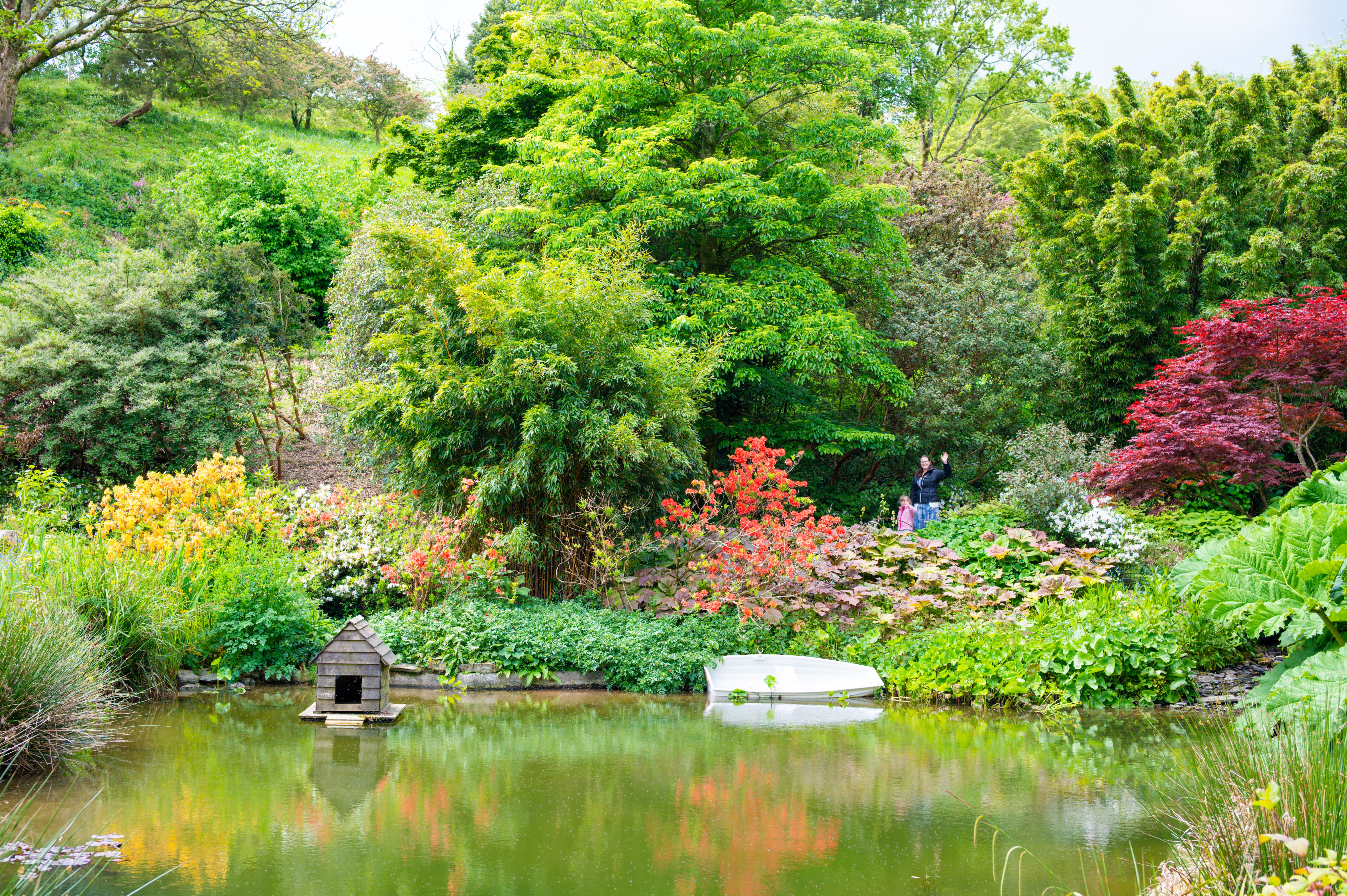
It is not, strictly speaking, normal behaviour to bring a scintillation spectrometer on a family holiday. The fault lies squarely with my parents. They had visited the property last year, spotting plenty of potential uranium glass, and that it might be (to paraphrase) “the sort of place worth scanning.”
The property is Coleton Fishacre, the Jazz Age country retreat of Rupert D’Oyly Carte - son of the Richard D’Oyly Carte who gave the world Gilbert and Sullivan and the Savoy Hotel - and his wife Lady Dorothy. Built between 1923 and 1926 by Oswald Milne, an early disciple of Lutyens, it sits in a coastal valley above Pudcombe Cove on the south Devon coast. This is an Art Deco property and the National Trust fitted the rooms appropriately.
The family only got a handful of happy years here before the saga turned sad. Their son was killed in a car accident in Switzerland in the early 1930s, the marriage did not survive it, and the estate was eventually sold to a motor trader called Rowland Smith in 1949. His widow, Freda, gifted it to the National Trust in 1982; a National Trust volunteer told me the house was valued at around £400,000 back then.
For readers outside the UK: the National Trust is a charity that looks after hundreds of historic houses, gardens and great swathes of coastline, opening them to the public and preserving them in perpetuity. Today Coleton Fishacre is preserved as a 1920s time capsule: a pianist plays in the lounge, sound beautifully travels around the property, only outmatched by the sea views from nearly every window, and - as I was about to discover - a genuinely interesting radiological character.
The courtyard surprise
I had barely cleared the threshold of the courtyard when the Radiacode started screaming. UK background runs at roughly 0.10 µSv/h on a normal day and I was seeing double that. Not alarming. Not even particularly noteworthy in absolute terms. But conspicuous, consistent, and decidedly not coming from anything I had brought with me.
The culprit was the stone. Granite is naturally radioactive - it carries trace uranium and thorium, and their decay chains throw off enough gamma to nudge a sensitive scintillator well above background. The local stone here, “quarried from the garden” as the guidebooks proudly note, is doing exactly what granite always does.
The effect followed me indoors, though more meekly. Internal readings were softer than the courtyard but still a touch elevated - I couldn’t work out if the house used granite throughout or if I was still picking up elevated readings from outside the property.
Uranium glass, quietly displayed
Then came the glass. Coleton Fishacre is decorated almost entirely in period, and the 1920s and 30s were, of course, the golden window for uranium glass in Britain. Once you have your eye in for the look - that slightly greasy, oily-yellow translucence, or the more honest neon green of the pressed pieces - you start spotting it everywhere: on side tables, on dressing tables, on the corner of a mantelpiece. Using a UV torch, a couple of pieces honestly glowed back.
The vases
The find of the day, however, was a pair of vases. They were displayed in the same room, and they had that unmistakable deep-orange, sandy, almost lava-like glaze of an early twentieth-century uranium-oxide ceramic - clearly a uranium glaze.
Both vases registered around 2.78 kCPM on contact - already a clear, decisive step above anything else in the room.
For the usual reassurance, a chest X-ray is around 14 µSv as a single shot, and a return transatlantic flight roughly 100 µSv. Even pressed up against the hotter of the two for a full minute, the dose you’re collecting is trivial. These are not health hazards. They are, however, thrilling - two objects sitting unremarked in a Devon country house, and I’m not sure even the volunteers realised what they were.
Worth the detour
If you’re curious about radioactive antiques, then Coleton Fishacre is certainly worth the trip. The architecture is genuinely beautiful, the gardens are packed with subtropical beauty, and the D’Oyly Carte story is the kind of melancholy English saga that lodges in the brain. But with a Radiacode in your pocket and a UV torch in the other, the house quietly upgrades itself further: it is very much alive and glowing with radioactivity.