

Most of my finds begin with a detector stirring into life in some dusty corner of an antique shop. This one began rather differently, with a house clearance.
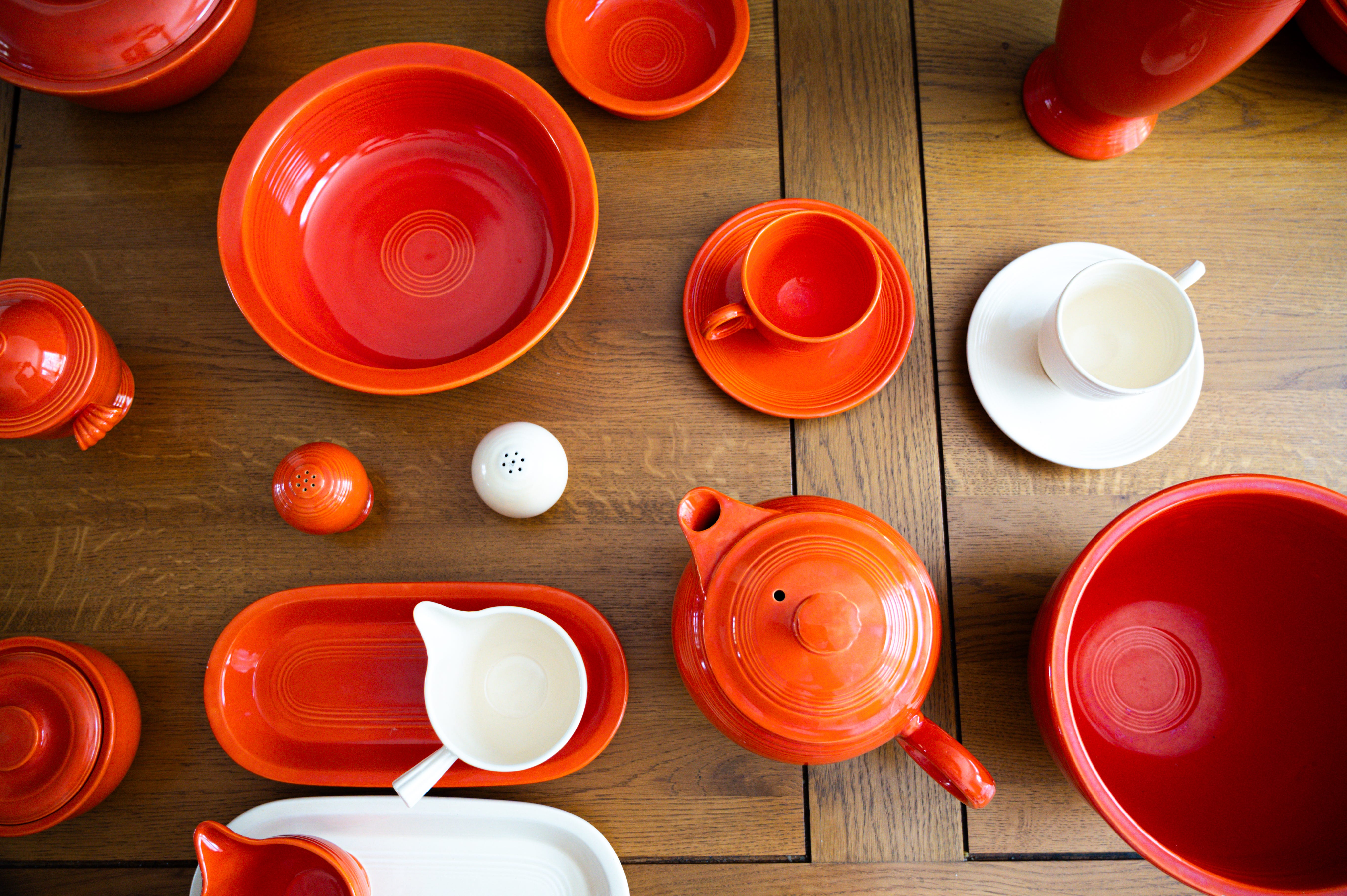
The collection had belonged to a lady, now sadly passed, who had spent many years building a careful and clearly much-loved set of vintage Fiestaware. Every colour was represented, neatly arranged, the work of someone who genuinely treasured it. I acquired a good part of the collection at an estate sale here in the UK, drawn in simply by the beauty of the pieces and a long-standing weakness for Art Deco dinnerware. Some of her Fiestaware was radioactive. I rather suspect she never knew.
That, for me, is the thrill of this hobby.
The uranium hiding in plain sight
Most of the collection is exactly what it appears to be: lovely, inert pottery. But among it were the pieces that matter to a collector like me, the genuine vintage “radioactive red”, that famous orange-red Fiesta glaze.
The surface of one red bowl reads around 4 usv/h (microsieverts) an hour on my Radiacode, roughly forty times background radiation with the probe held against it. There is ivory in the set as well, which tends to surprise people, because the ivory glaze also contains uranium and reads comfortably above background. It is often the plainest looking piece that proves the most active.
Why is Fiestaware red radioactive?
The answer lies in the glaze. To achieve those vivid colours, the Homer Laughlin China Company added uranium oxide. At the time, uranium was inexpensive and abundant, for the simple reason that very few people wanted it.
The prize of the age was radium. Extracting a single gram of it required several tonnes of uranium, and so the radium boom of the early twentieth century left behind enormous quantities of surplus uranium with little obvious purpose. Much of it was sold cheaply to the glass and ceramics trade as a colourant.
The history then takes a sharper turn. The radioactive reds were produced from 1936 until 1943, when the United States government requisitioned the nation’s uranium for the Manhattan Project. Fiestaware red disappeared. It returned in 1959, now made with depleted uranium, and was retired for good around 1972. Modern Fiestaware contains none at all, so every piece from this estate is unmistakably vintage.


Is radioactive Fiestaware safe to own?
This is the question I am asked most. Forty times background sounds alarming, but two things make it far less so. Radiation falls away quickly with distance: move half a metre from the bowl and the reading drops to barely above background. And even held against the skin for a full day, a piece would deliver roughly the same dose as two weeks of the natural background radiation we all live in. A single long-haul flight would give you more.
The real precautions are straightforward. Do not eat or drink from these pieces, as acidic foods such as tomato or citrus can leach uranium from the glaze into the food, and uranium is a toxic heavy metal as well as a radioactive one. And do not use chipped or damaged items, since a broken glaze can shed particles that are easily inhaled. Kept intact and on display, they are entirely safe to enjoy.
The principle, as ever on this blog, is a simple one. Respect it, do not fear it.
A second life for the collection
There is something rather satisfying in the thought that these pieces have found a second life, measured and understood rather than left to gather dust in a cupboard. Do take a look, and let me know in the comments what you would like me to measure next.


